
- Key Takeaways
- How Much Do Drone Pilots Make?
- Why Do Drone Pilot Salary Numbers Vary So Much?
- How Much Do Drone Pilots Make Per Hour?
- Hourly Pay for Employed Drone Pilots
- What Freelance Drone Pilots Charge
- Which Drone Jobs Pay the Most?
- Research & Development Operations
- Cinematography & Broadcast Pilots
- Drone Utility Inspection
- Agricultural Spraying
- Salaried Job vs. Freelance: Which Pays More?
- What Affects How Much a Drone Pilot Earns?
- Experience
- Location
- Specialized Skills
- Equipment
- How Do You Start Earning Money as a Drone Pilot?
- Frequently Asked Questions
- Is a Drone Pilot a Good Career?
- Can You Make $100,000 as a Drone Pilot?
- Do You Need a License to Get Paid to Fly a Drone?
- How Much Do Military Drone Pilots Make?
- How Much Do Real Estate Drone Pilots Charge?
- Conclusion
 Up to 50% off drone classesShop the sale →
Thinking about turning your drone hobby into a paycheck? It’s worth knowing what the job pays before you spend money on gear and training. As of November 2026, the average drone pilot salary in the U.S. runs from $48,122 a year (Salary.com) to $130,916 a year (ZipRecruiter).
That’s a big range, and it’s fair to wonder which number to trust. Part of the gap comes from how each site collects pay data. The rest comes down to the kind of flying you do. A senior pilot running power line inspections or crop spraying earns a lot more than someone shooting real estate listings on weekends.
Below, we’ll walk through what each major salary site reports and where the biggest paychecks are.
Key Takeaways
- Most salary sites put the average drone pilot salary between about $48,000 (Salary.com) and $130,916 (ZipRecruiter) as of November 2026.
- Freelance drone pilots can bill more per job but pay for their own gear, insurance, and taxes, while salaried pilots get steadier pay and benefits.
- Top-paying drone jobs include: R & D operations, broadcast cinematography, utility inspection, and agricultural spraying.
- You’ll need your Part 107 Remote Pilot Certificate to start earning.
Up to 50% off drone classesShop the sale →
How Much Do Drone Pilots Make?
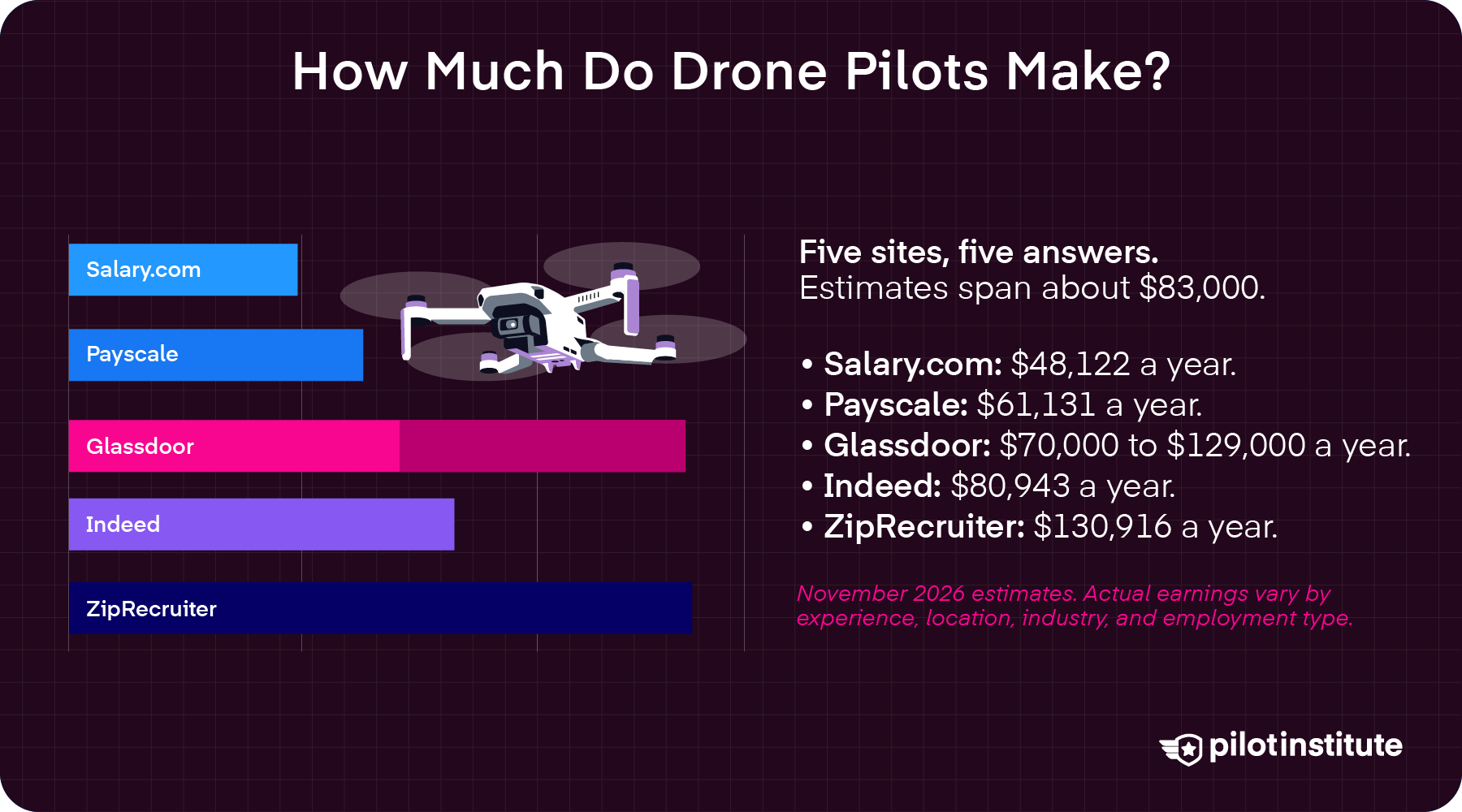
The average annual drone pilot salary ranges drastically depending on the source, job title, and industry.
As of November 2026, salary sites list average pay from $48,122 to $130,916. Salary.com lists the lowest annual pay rate at $48,122 (November 2026). Meanwhile, Payscale.com lists $29.39 an hour (September 2026), or about $61,131 a year on a 40-hour week. At the other end of the spectrum, ZipRecruiter reports a significantly higher annual pay of $130,916 (November 2026). In between are Indeed at $80,943 (September 2026) and Glassdoor at $93,963, with a typical range of $70,000 to $129,000 (October 2026).
| Source | Average Annual Pay | Hourly Equivalent |
|---|---|---|
| Salary.com (November 1, 2026) | $48,122 | $23.14 |
| Indeed.com (September 30, 2026) | $80,943 | $38.91 |
| Glassdoor.com (October 14, 2026) | $93,963 (typical range: $70,000 to $129,000) | $45.17 |
| ZipRecruiter.com (November 5, 2026) | $130,916 | $62.94 |
| Payscale.com (September 2, 2026) | $61,131 | $29.39 |
Why Do Drone Pilot Salary Numbers Vary So Much?
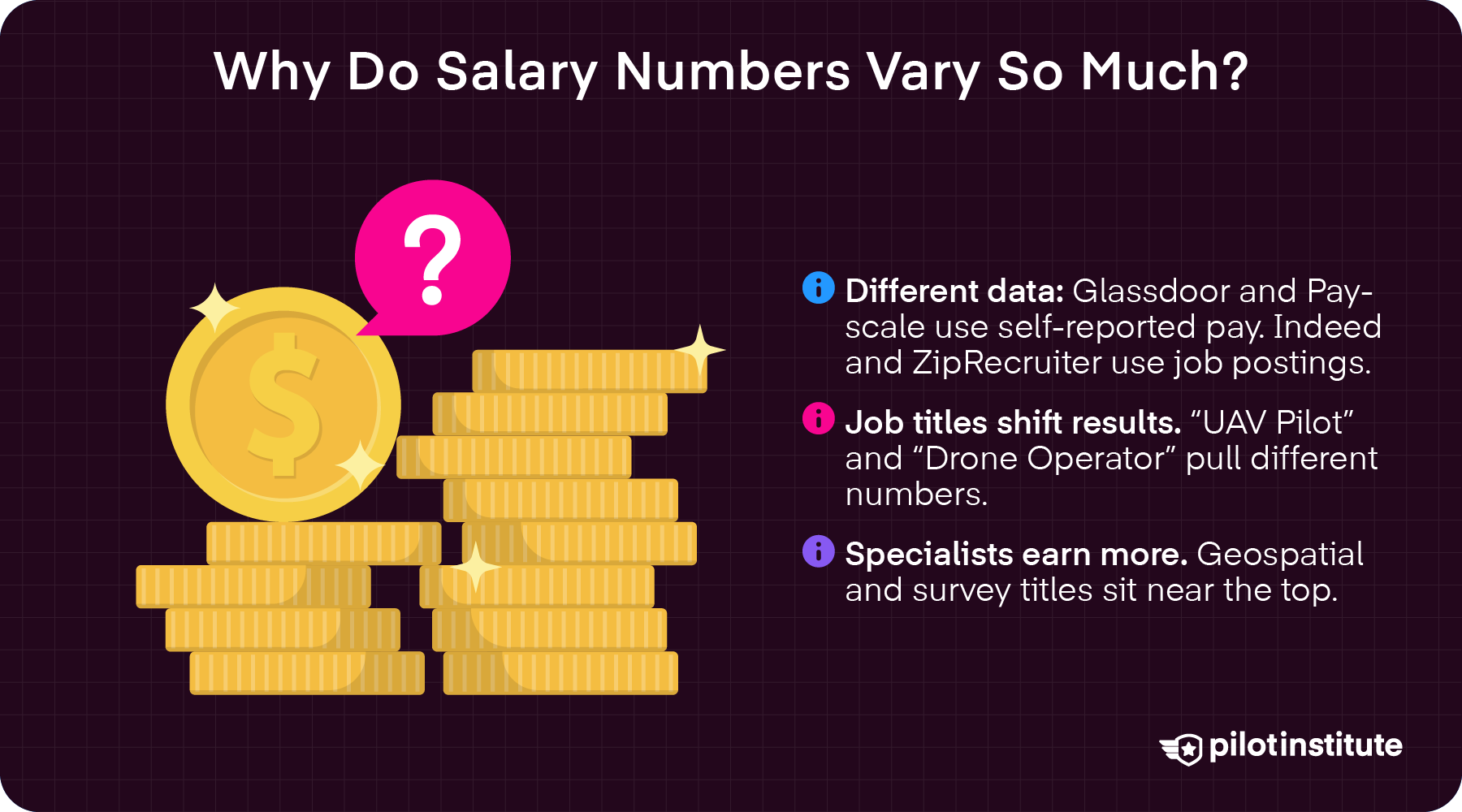
Well, each site measures something slightly different. Glassdoor, for example, uses self-reported salaries. Payscale uses both self-reported salaries and company-sourced compensation data. Meanwhile, Indeed and ZipRecruiter use job-posting estimates.
Drone job titles can also impact results. Searching for UAV Pilot or Drone Operator can change results. However, ZipRecruiter returns the same figure for its Part 107 Pilot and Drone Pilot Military pages, suggesting that it blends defense and military UAS roles into one estimate.
More specialized titles like UAV Surveyor/Geospatial Drone Specialist, for example, often pull in higher salaries as well.
How Much Do Drone Pilots Make Per Hour?
Hourly Pay for Employed Drone Pilots
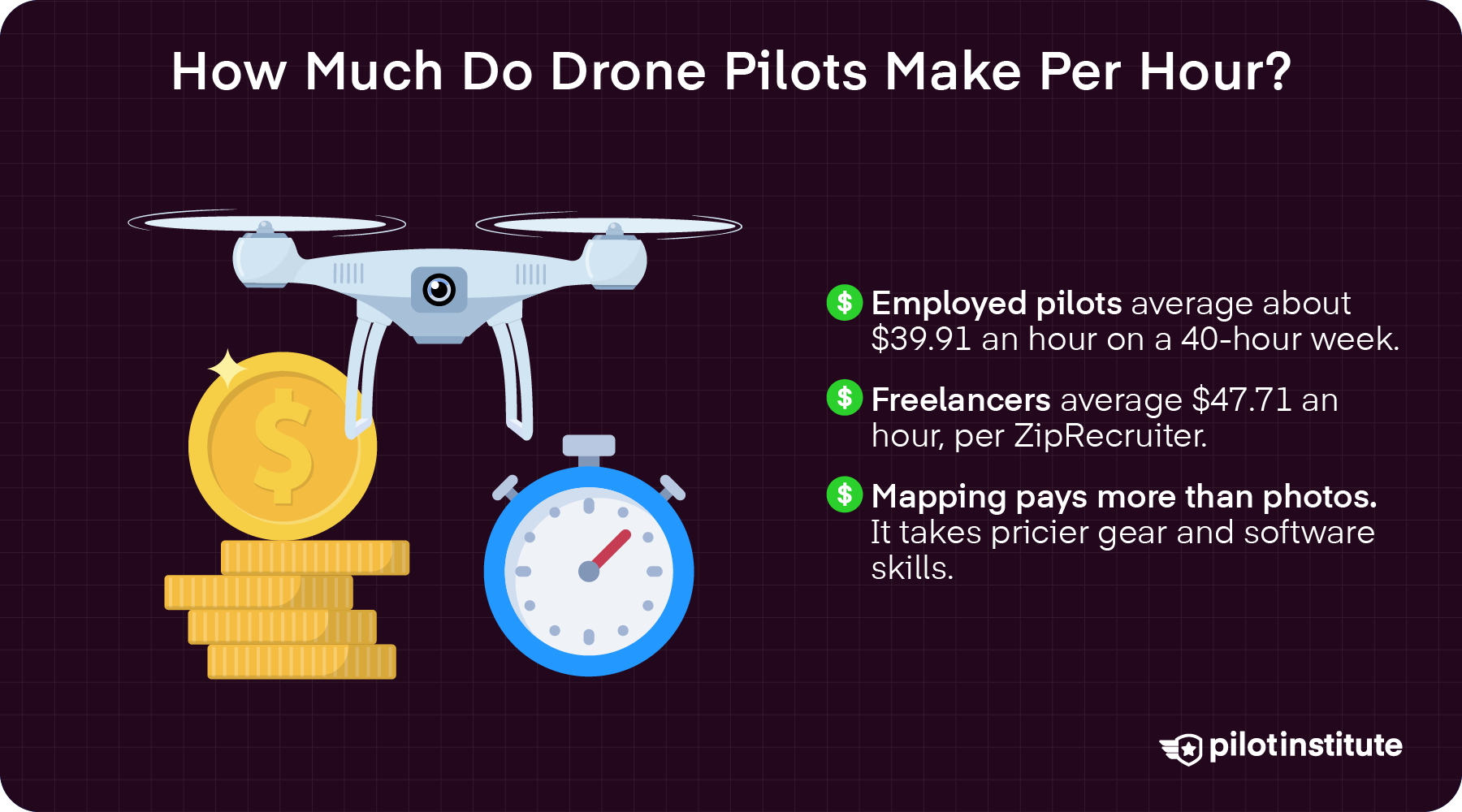
We compiled average hourly equivalents based on a 40-hour work week at 52 weeks a year. Averaged across all five sites, that comes to $39.91 an hour. ZipRecruiter lists this at a higher rate of $62.94 an hour, while Payscale says $29.39.
Like annual salaries, hourly drone rates can be quite different. This often depends on the type of work you’d be doing. Professional drone mapping services often net higher hourly rates because they involve expensive hardware, experience with complex software, and precise data collection, which is not required in drone photography.
What Freelance Drone Pilots Charge
As of October 2026, ZipRecruiter lists the hourly rate for a Freelance Drone Pilot at $47.71 an hour, higher than the $39.91 hourly equivalent of the five-site average salary of $83,015.
Again, your specialty will impact your hourly rate potential. Specialized services like mapping and inspections often command higher rates.
Which Drone Jobs Pay the Most?
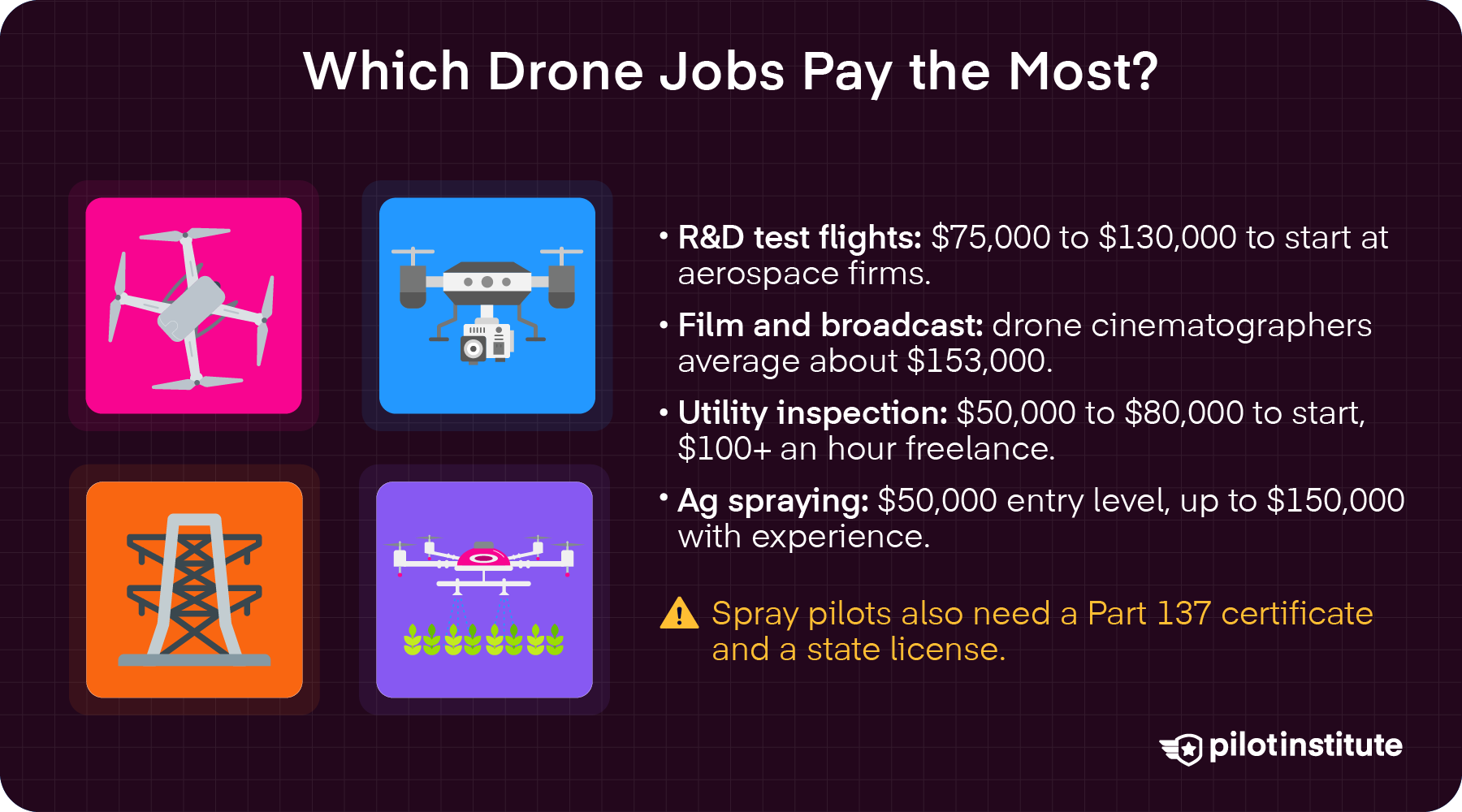
The highest-paying drone jobs are found in research and development operations, cinematography and broadcasting, drone utility inspection, agricultural spraying, and beyond visual line of sight (BVLOS) specialists.
Research & Development Operations
Drone pilots can earn top dollars conducting test flights and safety operations for aerospace and defense companies. These roles often involve testing new aircraft, evaluating autonomous flight systems, and monitoring unmanned aircraft during research and development.
Job listings on ZipRecruiter from October 2026 show starting salaries from $75,000 to $130,000 a year for drone test operators for aerospace products and manufacturing companies.
Cinematography & Broadcast Pilots
Pilots working in entertainment can earn significantly more than those in general aerial photography. Film productions, television broadcasts, and live events often pay a premium for skilled pilots who can capture dynamic footage in demanding environments.
Aerial cinematography for film and television offers lucrative pay for drone pilots. Drone Cinematography salaries average about $152,892 a year, or $73.51 an hour, according to ZipRecruiter (October 2026).
Sports and other event broadcasting is also a high-earner for drone pilots, reflecting the specialized skills and demands of professional sports coverage.
Drone Utility Inspection
While entry-level positions typically sit between $50,000 and $80,000, the big money comes for senior pilots working in specialties like utilities and oil and gas. These pilots offer thermal analysis, LiDAR mapping, and beyond visual line of sight (BVLOS) operations. Inspections of hard-to-reach infrastructure, such as wind turbines, power lines, and oil pipelines, can pay especially well.
Often, utility companies work with third-party aerial services companies to hire drone pilots when needed. Freelance positions with companies serving as a middleman between pilots and utility companies often involve hourly rates that can top $100 an hour, based on Indeed search estimates.
Pilots specializing in BVLOS operations can command higher pay because these missions require advanced flight planning, risk management, and compliance with changing FAA regulations.
As the FAA moves forward with Part 108 rulemaking, there are expanding opportunities for pilots specializing in BVLOS operations. While not in effect yet, Part 108 offers a regulatory framework for routine BVLOS flights that could help increase demand for pilots with the technical skills and safety knowledge these missions require.
Agricultural Spraying
Agricultural drone spraying involves applying fertilizers, pesticides, and other agricultural products across large fields, often using heavy-lift drones.
Like utility inspections, the best salaries are often reserved for senior pilots. Entry-level positions start around $50,000 a year, but can balloon up to $150,000 a year with the right experience and expertise, based on ZipRecruiter job application listings.
But just remember, spray work also requires an FAA Part 137 agricultural operator certificate and a state pesticide applicator license. Drones weighing 55 pounds or more with their load, which includes many spray drones, also need a 49 USC §44807 exemption.
Want to see what high-paying careers look like in practice? Check out the video below for another perspective on the opportunities available to drone pilots and the specialized skills that can help increase their earning potential.
Salaried Job vs. Freelance: Which Pays More?
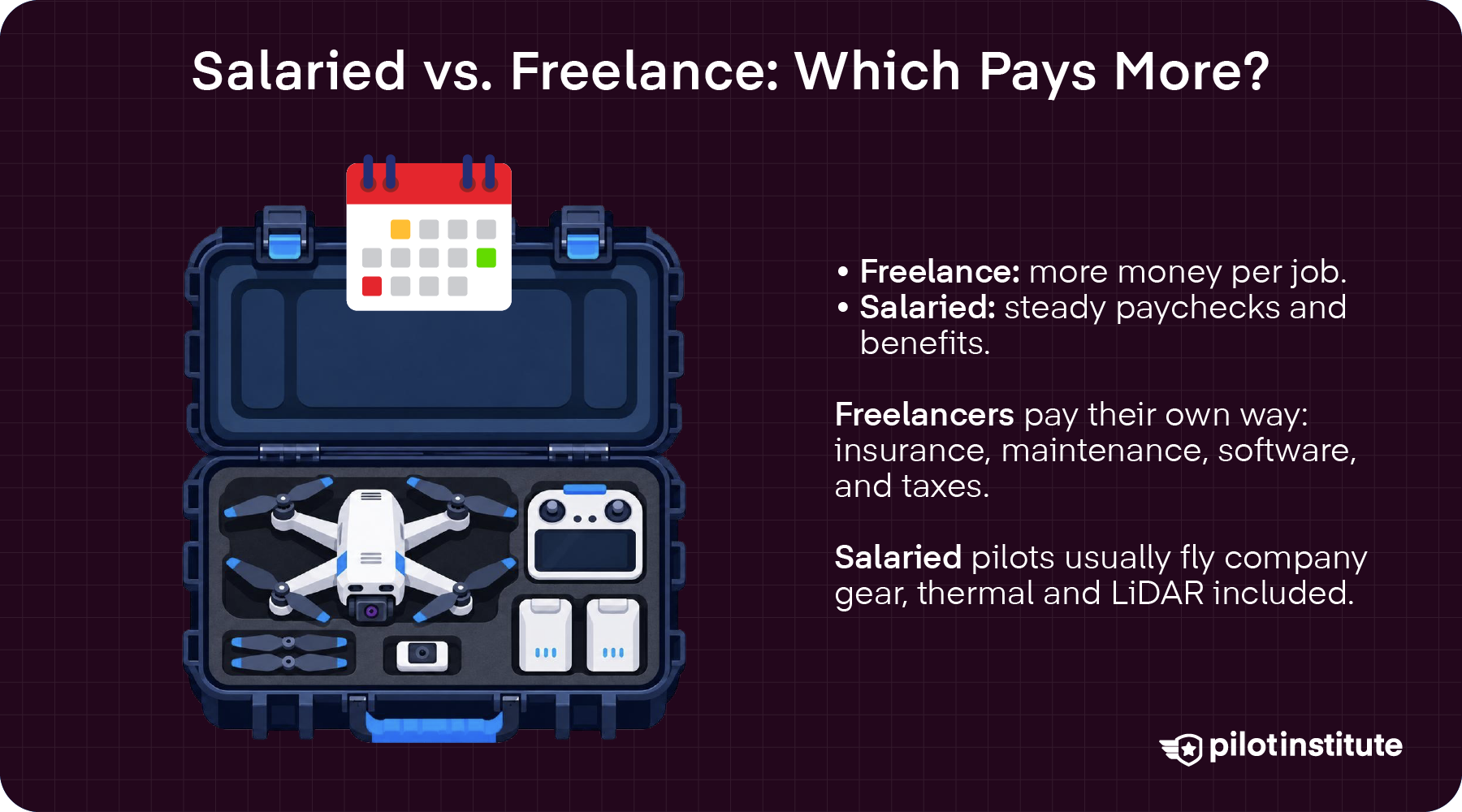
Short answer: freelancers earn more per job, but salaried pilots get steady pay and benefits.
Freelancers have to cover their own costs, including expenses like drone insurance, equipment maintenance, software, and taxes.
Salaried pilots often also don’t have to pay for their own gear. With the cost of drones and specialty payloads like thermal cameras or LiDAR sensors, these expenses can add up quickly.
Ultimately, freelancing is best suited for pilots who value flexibility, don’t mind the grind to find their own clients, and are comfortable managing business expenses and inconsistent workloads.
Salaried positions are a better fit for pilots who prefer predictable income, employer-provided equipment, and a more structured work environment.
Not sure what to charge for your budding freelance drone career? Check out our Drone Business Made Easy course to learn how to build a business plan, price your services, and start making money ASAP.
What Affects How Much a Drone Pilot Earns?
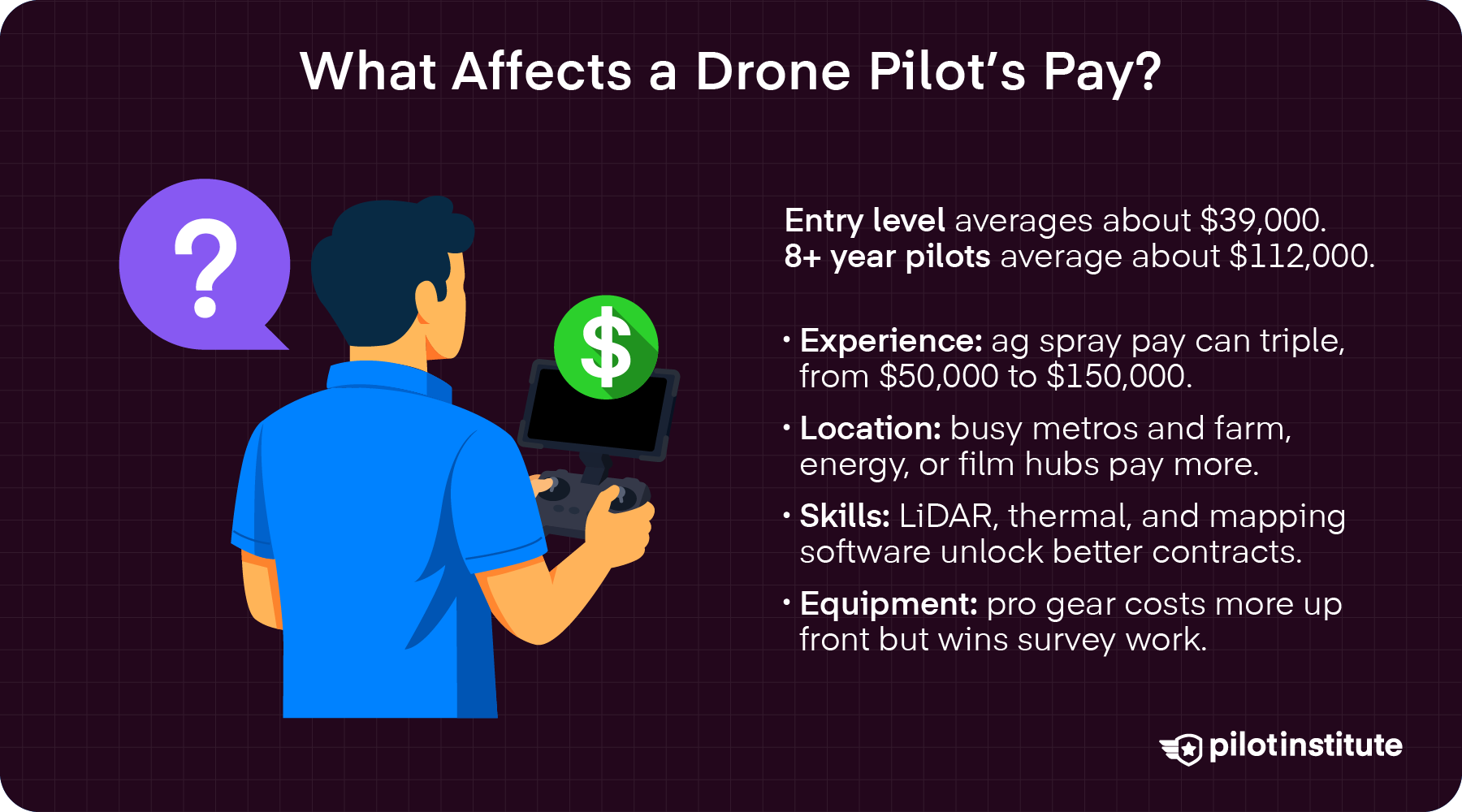
Drone pilots with less than a year of experience average $39,067 a year (Salary.com, November 2026). Those with more than eight years of experience average $111,862, according to the same source. So, what’s the difference?
A UAV pilot’s earnings depend on several factors, including their experience, location, specialty, and equipment.
Experience
Entry-level pilots typically start with simpler assignments, while experienced pilots can qualify for more complex, higher-paying jobs.
In agricultural spraying, for example, entry-level roles start around $50,000, about a third of the $150,000 some senior pilots earn.
Building a strong portfolio, developing specialized skills, and demonstrating a reliable safety record can help pilots command higher rates over time.
Location
Pilots working in major metropolitan areas or regions with a strong demand for aerial services may earn more than those in less active markets.
Industries concentrated in certain regions, such as agriculture, energy, and film production, can also create opportunities for higher-paying work.
Specialized Skills
UAV pilots experienced in LiDAR mapping, thermal imaging, or infrastructure inspections may command higher rates.
Pilots with experience obtaining Part 107 waivers and using specialized flight-planning or mapping software, like DroneDeploy, UgCS, or Pix4D, can qualify for higher-paying roles that require advanced mission planning and precise data collection.
Equipment
Professional equipment can require a significant upfront investment, but the right setup can help pilots qualify for lucrative mapping and surveying contracts.
How Do You Start Earning Money as a Drone Pilot?
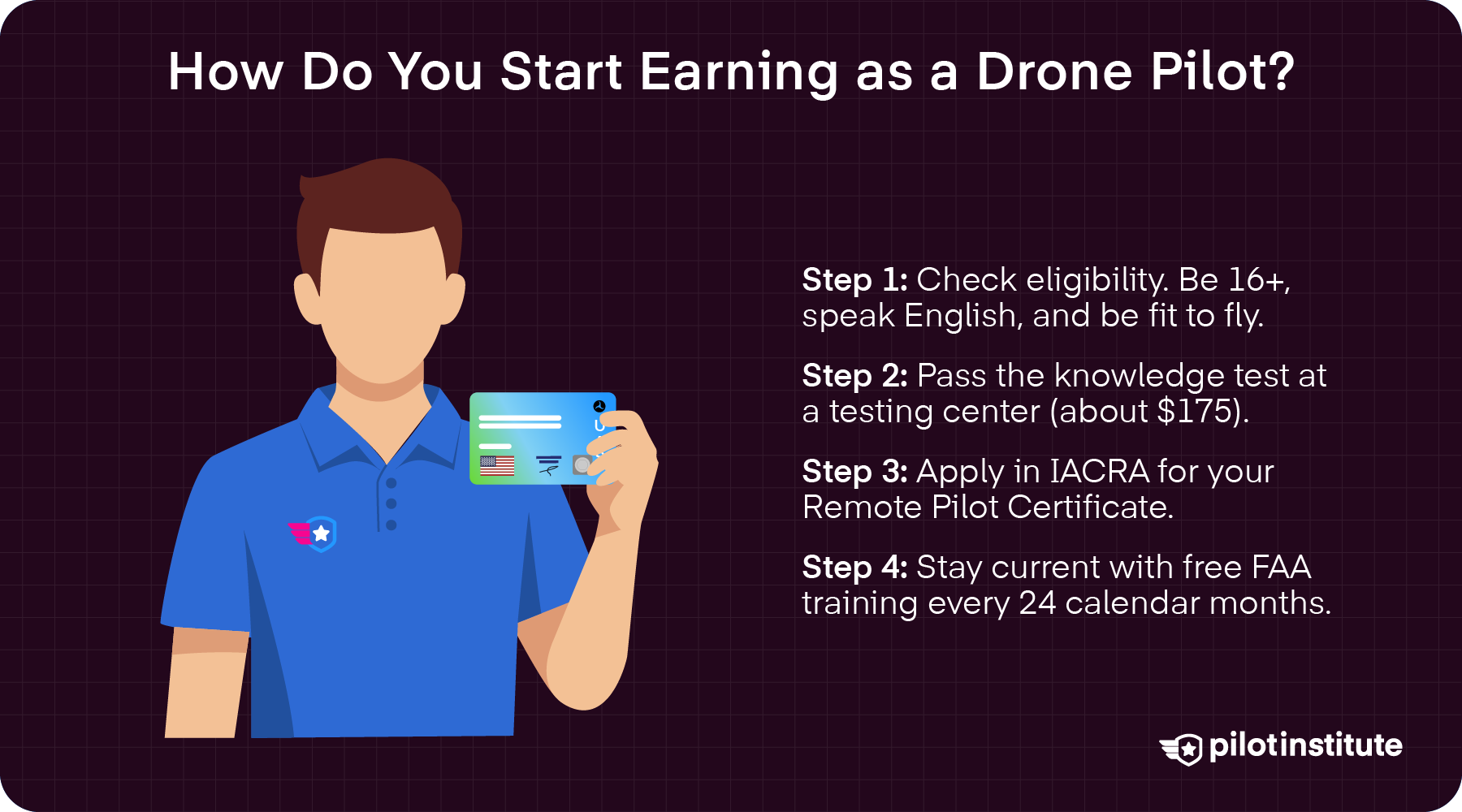
You need an FAA Remote Pilot Certificate under Part 107 before you can fly for pay.
To earn your Part 107 Remote Pilot Certificate, you must meet the eligibility requirements outlined in 14 CFR §107.61. Applicants must be at least 16 years old, able to read, speak, write, and understand English, and free of any known physical or mental condition that would interfere with safe drone operations.
First-time applicants must also pass the FAA’s aeronautical knowledge test, which costs about $175 at an authorized testing center. Under 14 CFR §107.65, remote pilots must complete free FAA online recurrent training every 24 calendar months to maintain eligibility.
Ready to turn your love for drones into a lucrative career? Our Part 107 Made Easy course is your best friend when studying for the FAA knowledge test.
Frequently Asked Questions
Is a Drone Pilot a Good Career?
Yes, drone pilots can enjoy great pay rates, especially the longer they keep at it. While entry-level pilots average about $39,067 a year, more senior-level pilots with over eight years of experience average $111,862 (Salary.com, November 2026).
Can You Make $100,000 as a Drone Pilot?
Yes, mostly in specialized roles. Agricultural spray pilots can make $150,000, for example. Most entry-level pilots average closer to $39,067 a year (Salary.com, November 2026).
Do You Need a License to Get Paid to Fly a Drone?
Yes. To fly a drone for any business purpose in the U.S., you need an FAA Part 107 Remote Pilot Certificate. Military and other government pilots operate under separate rules.
How Much Do Military Drone Pilots Make?
Military pay follows rank and grade (see the current DoD basic pay tables). Overall, seniority, years of service, and special duty can increase overall compensation.
A junior commissioned officer, pay grades O-1 to O-3, for example, starts at $4,150.20 per month in 2026. Meanwhile, a junior enlisted member at pay grade E-1 earns $2,407.20 per month after four months of service.
How Much Do Real Estate Drone Pilots Charge?
Rates can vary by market location, but a standard real estate package of edited photos and a short video typically runs about $150 to $350 per shoot (SkyeBrowse, March 2026).
Conclusion
That drone you love to fly in your spare time can be a valuable business asset.
The right combination of skills, specialization, experience, and equipment can help you command big paychecks and lucrative contracts. Pick a niche and use local job postings to set realistic expectations.
The key is knowing where your skills are most valuable and investing in the tools to meet that demand.